

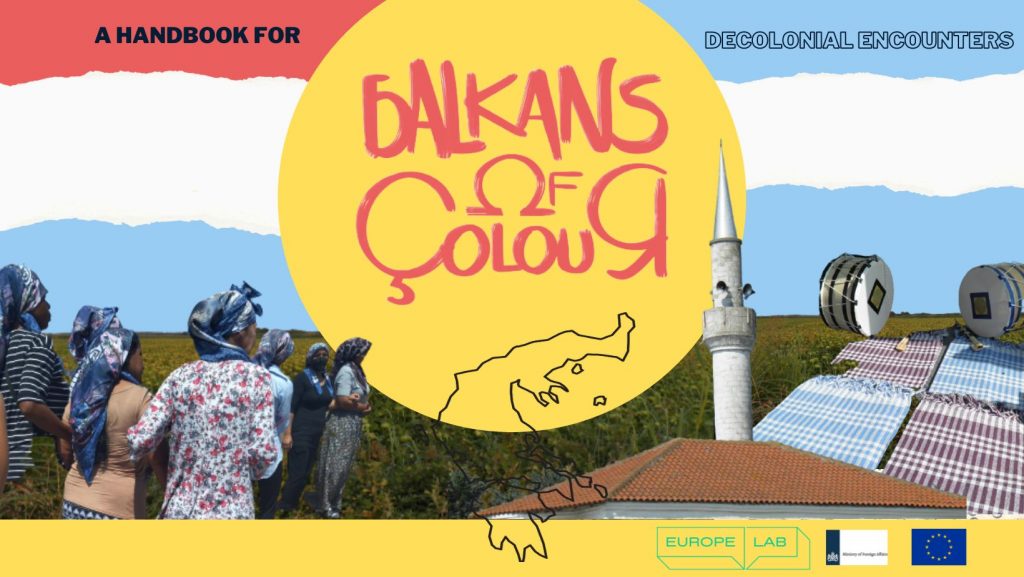
The research team of the project “Balkans of Colour – A Handbook for Decolonial Encounters” is thrilled to present the third and last section of their work regarding the ‘Other’ Plain of Xanthi. This section was organized, curated, and authored by Natasa Chanta-Martin. It begins with a theoretical introduction to the Afro-Greek communities and African legacies in Northern Greece. It is followed by a three-level component of practical exercises and activities.
This third and last section of the handbook is meant to engage a wide range of students, scholars, experts, and youngsters who might be interested in knowing more about Afroeuropean culture and Afro-Greeks residing in Northeast Greece.
Theory: “Speaking of Race and African Legacies in Northern Greece” – DOWNLOAD HERE.
1) Beginners: “Exploring African Legacies and Ontologies in Northern Greece”
This section is meant to engage a group of beginners with little knowledge about Afroeuropean communities, identities, and histories. DOWNLOAD HERE.
2) Medium: “Decolonial Encounters in Greece: The Greek Citizens of Muslim Religion and African Descent”
This section is meant to engage an audience who is already familiar with minority issues on Black/African populations in Greece and Europe and both history and legacies of colonialism in the region and beyond. DOWNLOAD HERE.
3) Advanced: “Two Avatos: The New and the Old, the West and the Rest”
This section is meant to engage an audience of people with an advanced level of knowledge about minority groups, colonialism, and post-/de-colonial perspectives. DOWNLOAD HERE.
Each of these sections is provided with a guideline, including some suggestions and recommendations for educators, teachers, and practitioners who would like to use the handbook for potential training and workshop.
More Info:
Author: Natasa Chanta Martin is an independent researcher, civil society professional, and artist from Athens Greece. Her background is in Social Sciences (BA Sociology, MA Dance Anthropology) and she has conducted research in Nigeria among the Yoruba and in Europe as a national expert for the European Network Against Racism (E.N.A.R.) on Afrophobia in Europe and on the intersection between migration and discrimination. Since 2012, she has been part of Anasa Cultural Center, an Afrocentric grassroots association in Greece. For the past decade, she has worked in the migrant and refugee sector in various NGOs as well as an assistant manager at a refugee camp in Greece of about 850 residents. Natasa is an advocate for decolonizing practices around the globe with a focus on topics such as access to national citizenship, civil society, integration, and racial equity.
This project was implemented as a part of Europe Lab, the Dutch Ministry of Foreign Affairs, and the European Union. The toolkit’s contents are the authors’ responsibility and can in no way be taken to reflect the views and opinions of Europe Lab, their donors, and the NGO Forum for Glocal Change. The opinions expressed by the authors are their own and do not represent the views of the institutions, organizations, and professional entities they are professionally affiliated.